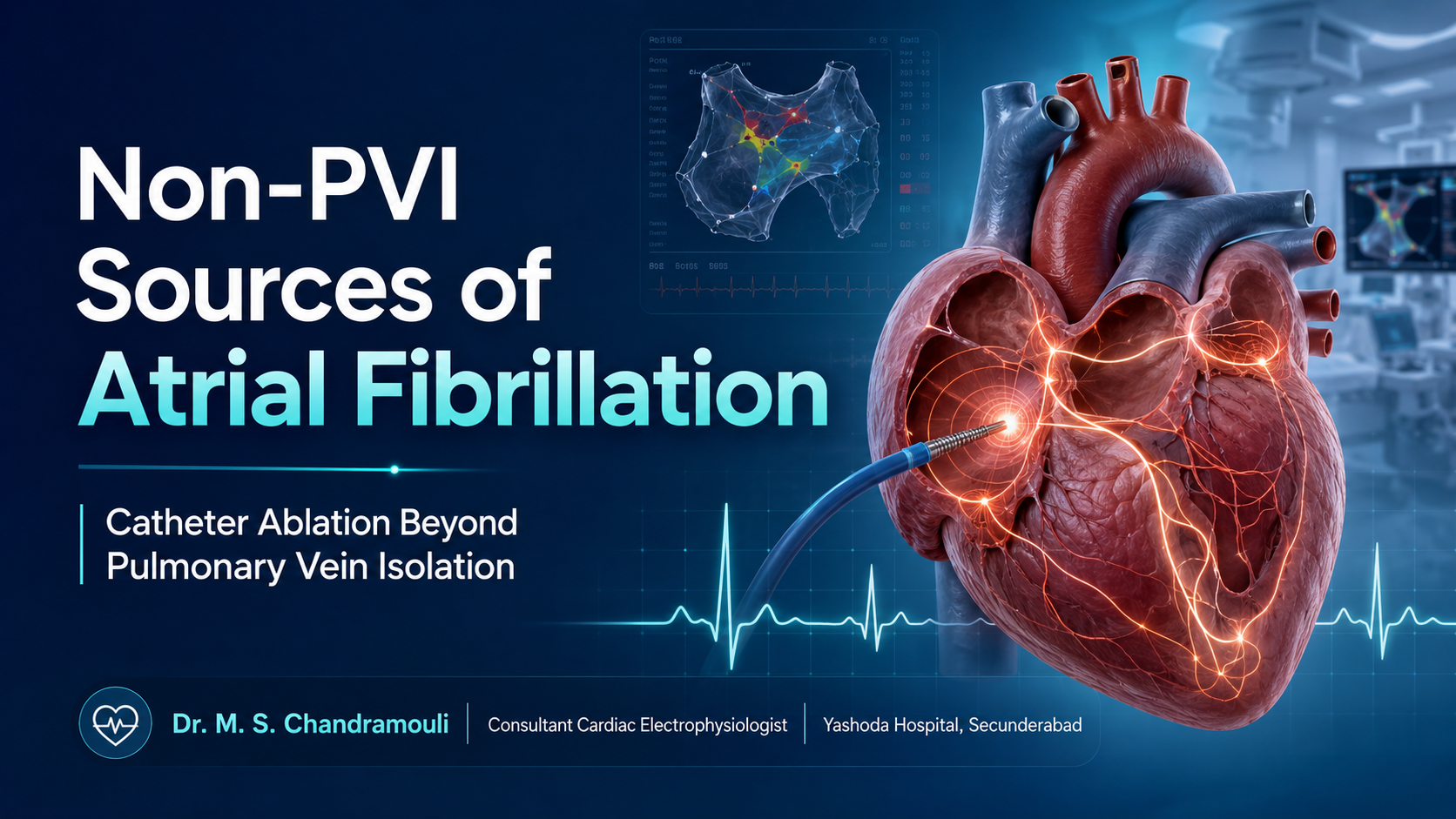
Atrial fibrillation, commonly known as AF, is one of the most common heart rhythm disorders. In AF, the upper chambers of the heart beat irregularly and often rapidly, leading to symptoms such as palpitations, breathlessness, fatigue, dizziness, reduced exercise tolerance, and sometimes chest discomfort. In some patients, AF may also increase the risk of stroke and heart failure if not managed properly.
For many years, catheter ablation for AF has mainly focused on a procedure called Pulmonary Vein Isolation, or PVI. This is because the pulmonary veins, which bring oxygen-rich blood from the lungs to the left atrium, are a common source of abnormal electrical signals that trigger AF. PVI works by electrically isolating these veins so that abnormal signals cannot spread into the rest of the atrium.
However, not every case of AF is driven only by the pulmonary veins. In many patients, especially those with persistent AF, long-standing persistent AF, enlarged atria, previous failed ablation, or advanced atrial remodeling, the source of AF may lie beyond the pulmonary veins. These are known as Non-PVI sources or non-pulmonary vein triggers.
Understanding these non-PVI sources is important because it helps electrophysiologists create a more personalized and effective ablation strategy.
Why Pulmonary Vein Isolation Alone May Not Be Enough
PVI remains the foundation of AF ablation. It is still one of the most important and proven steps in rhythm control. But in real-world practice, some patients continue to experience AF even after technically successful PVI.
This may happen because AF is not always a single-trigger disease. It often involves three major components:
1. Triggers: Abnormal electrical beats that start AF.
2. Substrate: Diseased or remodeled atrial tissue that allows AF to continue.
3. Modulators: Factors such as autonomic nervous system activity, inflammation, sleep apnea, alcohol, obesity, high blood pressure, diabetes, and atrial stretch that lower the threshold for AF.
When AF becomes persistent, the atrial tissue itself may become electrically and structurally abnormal. Fibrosis, low-voltage areas, atrial enlargement, and altered conduction patterns can sustain AF even when the pulmonary veins are already isolated.
This is why modern AF ablation is moving from a “PVI-only” approach toward a more individualized strategy based on mapping, trigger identification, substrate assessment, and patient-specific risk factors.
What Are Non-PVI Sources of AF?
Non-PVI sources are abnormal electrical trigger sites located outside the pulmonary veins. These sites may either initiate AF directly or help maintain it by creating unstable electrical circuits.
Common non-PVI sources include:
Superior vena cava: One of the most common non-PV trigger sites. It can contain muscular sleeves capable of generating abnormal electrical activity.
Vein of Marshall: A small vein and ligament-like structure near the left atrium. It is important because it contains muscle fibers and nerve connections that can trigger AF and support atrial flutter circuits.
Left atrial posterior wall: This area shares an embryological relationship with the pulmonary veins and may act as a substrate for persistent AF.
Coronary sinus: A venous structure with muscular connections to the atria that can participate in abnormal rhythms.
Crista terminalis: A structure in the right atrium that may act as a trigger site due to anisotropic conduction.
Left atrial appendage: In some patients, especially those with recurrent or long-standing persistent AF, the left atrial appendage may become an important trigger source.
Interatrial septum and Bachmann’s bundle: These are less common sites but may be involved in complex or repeat cases.
How Doctors Identify Non-PVI Triggers
Non-PVI triggers are not always visible during the beginning of the procedure. Many of them are “dormant,” meaning they may only appear when the heart is stressed or stimulated.
During an electrophysiology study, the doctor may use specialized techniques to unmask these triggers. This can include high-density mapping, electrical pacing, cardioversion, medication challenge, and observation of the first abnormal beat that restarts AF.
A careful mapping strategy helps the electrophysiologist understand whether the rhythm problem is coming from the pulmonary veins, another focal trigger, a scar-related substrate, or an atrial circuit.
This step is very important because unnecessary ablation can increase risk without improving success. The goal is not to ablate more tissue blindly, but to ablate the right tissue accurately.
Vein of Marshall: A Key Target in Persistent AF
The Vein of Marshall has become one of the most important non-PVI targets in advanced AF ablation. It is located near the left atrium and mitral isthmus. It can contribute to AF in three ways: as a trigger source, as a pathway for reentry circuits, and as an autonomic modulator.
One advanced technique is Vein of Marshall ethanol infusion. In this approach, ethanol is delivered into the vein to create a controlled scar in the region. This may help eliminate Marshall-related triggers, improve mitral isthmus block, and reduce autonomic input that promotes AF.
This technique is usually considered in selected patients with persistent AF, perimitral flutter, repeat ablation, or cases where a more comprehensive lesion set is needed.
Superior Vena Cava Isolation
The superior vena cava, or SVC, is another important non-PV trigger site. It is a large vein that carries blood from the upper body to the heart. In some patients, muscular sleeves extend into this vein and can fire abnormal electrical impulses.
SVC isolation may be performed when the SVC is clearly shown to be triggering AF. However, this area requires careful technique because of nearby structures such as the phrenic nerve and sinus node. Phrenic nerve injury and sinus node injury are important safety concerns, so mapping and pacing precautions are essential before ablation.
Posterior Wall Isolation: Useful, But Not for Everyone
The left atrial posterior wall has been studied as an additional ablation target, especially in persistent AF. The reasoning is strong: the posterior wall shares developmental characteristics with the pulmonary veins and may contain complex electrical activity.
However, evidence suggests that routine posterior wall isolation for every persistent AF patient may not always improve outcomes. A more selective approach may be better. Patients with rapid posterior wall activity, long-standing persistent AF, larger atria, or repeat procedures may benefit more than those without clear posterior wall involvement.
Another important concern is safety. The esophagus lies close behind the posterior wall, so ablation in this region must be performed carefully.
Left Atrial Appendage Isolation
The left atrial appendage, or LAA, is usually discussed in relation to stroke risk in AF, but it can also act as an electrical trigger source. In some long-standing persistent AF cases or repeat ablation cases, LAA isolation may improve rhythm outcomes.
However, this is not a routine step for all patients. Electrically isolating the LAA can reduce its mechanical function, which may increase clot formation risk. Therefore, patients who undergo LAA isolation may require long-term anticoagulation or consideration of left atrial appendage closure, depending on their clinical situation.
Substrate-Based Ablation and Atrial Fibrosis
AF becomes more difficult to treat when the atrium develops fibrosis and low-voltage areas. This condition is often described as atrial cardiomyopathy. In these patients, AF is not only a trigger problem; it is also a tissue disease.
Substrate-based ablation aims to modify or isolate diseased atrial tissue that helps maintain AF. Voltage mapping inside the heart can identify low-voltage regions that may represent fibrosis. In selected patients, modifying these areas may improve outcomes.
However, substrate ablation must be individualized. Excessive ablation without a clear target may increase procedure time, risk, and atrial tachycardia without improving long-term rhythm control.
Utah Classification: Understanding Atrial Fibrosis
The Utah classification uses cardiac MRI to estimate the amount of fibrosis in the left atrium. It helps classify patients into stages based on the percentage of atrial wall fibrosis.
In simple terms:
Utah I: Minimal fibrosis; usually better ablation outcomes.
Utah II: Mild fibrosis; still a good candidate for PVI-based ablation.
Utah III: Moderate fibrosis; may need additional individualized strategies.
Utah IV: Severe fibrosis; lower chance of durable rhythm control with standard catheter ablation.
This classification is useful for patient counseling and treatment planning. It helps doctors explain realistic expectations before the procedure.
Hybrid Convergent Ablation for Advanced AF
For patients with long-standing persistent AF, enlarged atria, significant fibrosis, or previous failed catheter ablation, a hybrid approach may be considered. Hybrid convergent ablation combines epicardial ablation performed from outside the heart with endocardial catheter ablation performed from inside the heart.
This approach allows better treatment of the posterior wall and complex atrial substrate. It may be especially useful in advanced AF where a standard catheter-only approach may not be enough.
Patient Selection Matters
The most important lesson in modern AF ablation is that no single strategy works for everyone. A young patient with paroxysmal AF and minimal atrial disease may do very well with PVI alone. A patient with persistent AF, enlarged left atrium, sleep apnea, hypertension, obesity, and fibrosis may need a broader strategy.
Successful AF treatment also requires risk-factor management. Treating sleep apnea, controlling blood pressure, reducing weight, managing diabetes, avoiding excess alcohol, improving fitness, and maintaining regular follow-up can all improve rhythm outcomes.
Conclusion
Non-PVI sources of AF are an important reason why some patients continue to experience atrial fibrillation after standard pulmonary vein isolation. These sources may include the superior vena cava, vein of Marshall, posterior wall, coronary sinus, crista terminalis, left atrial appendage, septum, and areas of atrial fibrosis.
Modern AF ablation is no longer only about isolating the pulmonary veins. It is about understanding the individual patient’s rhythm mechanism, atrial substrate, trigger sites, and overall health condition. A personalized approach can help improve outcomes, especially in persistent, long-standing persistent, and recurrent AF.
For patients with complex AF, consultation with an experienced cardiac electrophysiologist is essential.
Doctor Details
Dr. M. S. Chandramouli
MD, DM, IDCC, PDF, ECDS
Consultant Cardiac Electrophysiologist
Yashoda Hospital, Secunderabad
Dr. M. S. Chandramouli specializes in advanced heart rhythm disorders, electrophysiology studies, catheter ablation, atrial fibrillation management, complex arrhythmia treatment, and device-based rhythm therapies.
FAQs
1. What is PVI in atrial fibrillation treatment?
PVI stands for Pulmonary Vein Isolation. It is a catheter ablation technique that electrically isolates the pulmonary veins, which are common sources of abnormal signals that trigger AF.
2. What are non-PVI sources of AF?
Non-PVI sources are AF triggers located outside the pulmonary veins. These may include the superior vena cava, vein of Marshall, posterior wall, coronary sinus, crista terminalis, left atrial appendage, and atrial scar regions.
3. Why does AF come back after ablation?
AF can return if pulmonary veins reconnect, if non-PV triggers are present, or if the atrial tissue has advanced fibrosis or electrical remodeling. Lifestyle and medical conditions like sleep apnea, obesity, hypertension, and diabetes can also contribute.
4. Is non-PVI ablation required for every patient?
No. Many patients, especially those with paroxysmal AF and minimal atrial disease, may do well with PVI alone. Non-PVI ablation is usually considered in persistent AF, long-standing persistent AF, repeat procedures, or when mapping identifies additional triggers.
5. What is Vein of Marshall ethanol ablation?
It is an advanced technique where ethanol is delivered into the vein of Marshall to target AF triggers, autonomic inputs, and mitral isthmus-related circuits. It is mainly used in selected persistent AF or complex rhythm cases.
6. Is left atrial appendage isolation safe?
It can be effective in selected patients, but it may increase clot-related risk if the appendage loses mechanical function. Patients may require lifelong anticoagulation or left atrial appendage closure depending on their condition.
7. What is the Utah classification?
The Utah classification uses cardiac MRI to estimate left atrial fibrosis. It helps doctors predict ablation success and choose the right treatment strategy.
8. Who should consider advanced AF ablation?
Patients with persistent AF, long-standing persistent AF, recurrent AF after previous ablation, enlarged left atrium, significant fibrosis, or suspected non-PV triggers should consult an electrophysiologist for advanced evaluation.