Pacing the Unusual Heart: Conduction System Pacing in CCTGA
A 27-year-old with congenitally corrected transposition (CCTGA) and a heart rate of 49. How 3D mapping guided a single conduction system pacing lead and kept the paced QRS at 126 ms.
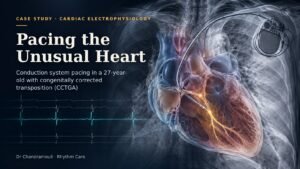
A 27-year-old with congenitally corrected transposition (CCTGA) and a heart rate of 49. How 3D mapping guided a single conduction system pacing lead and kept the paced QRS at 126 ms.
A heartbeat that suddenly becomes fast, irregular or unusually slow can be frightening. Some people describe the sensation as fluttering, pounding, racing, skipped beats or a pause inside the chest. Others may experience dizziness, fainting, breathlessness or unexplained weakness without noticing any obvious change in their heartbeat. These symptoms can sometimes originate from a problem […]
An irregular heartbeat can feel like fluttering, pounding, racing, skipped beats or an unexpected pause in the chest. Sometimes these sensations are harmless, but they may also be caused by an abnormal electrical rhythm that requires evaluation by a heart-rhythm specialist. If you are searching for the best electrophysiologist in Hyderabad, it is important to […]
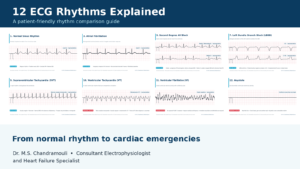
By Dr. M.S. Chandramouli, MD, DM, IDCCM, PDF(EP), ECDS Consultant Electrophysiologist and Heart Failure Specialist, Yashoda Hospitals, SecunderabadAn electrocardiogram (ECG or EKG) records the heart’s electrical activity. These illustrations are educational schematics, not patient tracings, and are not intended for self-diagnosis. An ECG can reveal whether an impulse begins in the expected place, travels normally […]
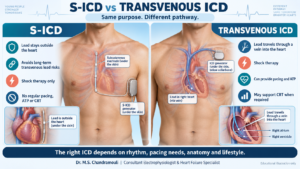
A 22-year-old with hypertrophic cardiomyopathy or an inherited electrical heart condition may need protection from sudden cardiac death for several decades. For such a young patient, the concern is not only whether an implantable cardioverter-defibrillator can treat a dangerous heart rhythm. The long-term implications of placing a lead inside a blood vessel and the heart […]
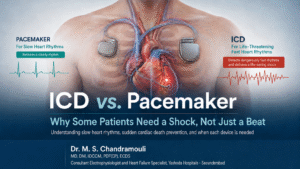
Many patients use the words pacemaker and ICD interchangeably. Although both are small electronic devices implanted to manage heart rhythm problems, they are designed for very different situations. A pacemaker primarily supports a heart that is beating too slowly or whose electrical signals are not travelling properly. An implantable cardioverter-defibrillator, or ICD, is designed to […]
An irregular heartbeat is not always caused by stress or anxiety. Repeated palpitations, unexplained fainting, a very slow heartbeat, breathlessness or sudden episodes of a racing heart may be signs of an electrical problem within the heart. Patients experiencing these symptoms may need evaluation by a cardiac electrophysiologist, a cardiologist with additional training in diagnosing […]
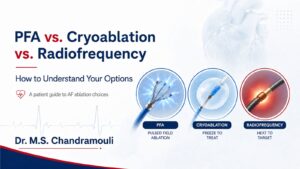
PFA vs. Cryoablation vs. Radiofrequency: How to Understand Your Options When a patient is advised to undergo catheter ablation for atrial fibrillation, the next question is often not whether ablation can help. It is: “Which type of ablation should I choose?” Pulsed field ablation (PFA), cryoballoon ablation and radiofrequency ablation all aim to electrically isolate […]

For many patients considering catheter ablation for atrial fibrillation, the first question is not whether the technology is advanced or whether the procedure is faster. The first question is usually: “Is pulsed field ablation safe?” The most accurate answer is encouraging, but it should also be honest. Pulsed field ablation, commonly known as PFA, appears […]
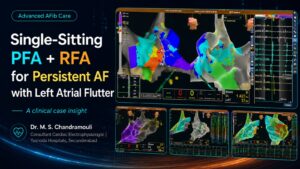
When an Irregular Heart Rhythm Needs More Than Medicines by – Dr. M. S. Chandramouli, MD, DM, IDCC Consultant Cardiac Electrophysiologist, Department of Cardiology Yashoda Hospitals, Secunderabad Atrial fibrillation, often called AFib or AF, can be frightening because it changes something people usually take for granted: the steady rhythm of the heart. A normal heartbeat […]