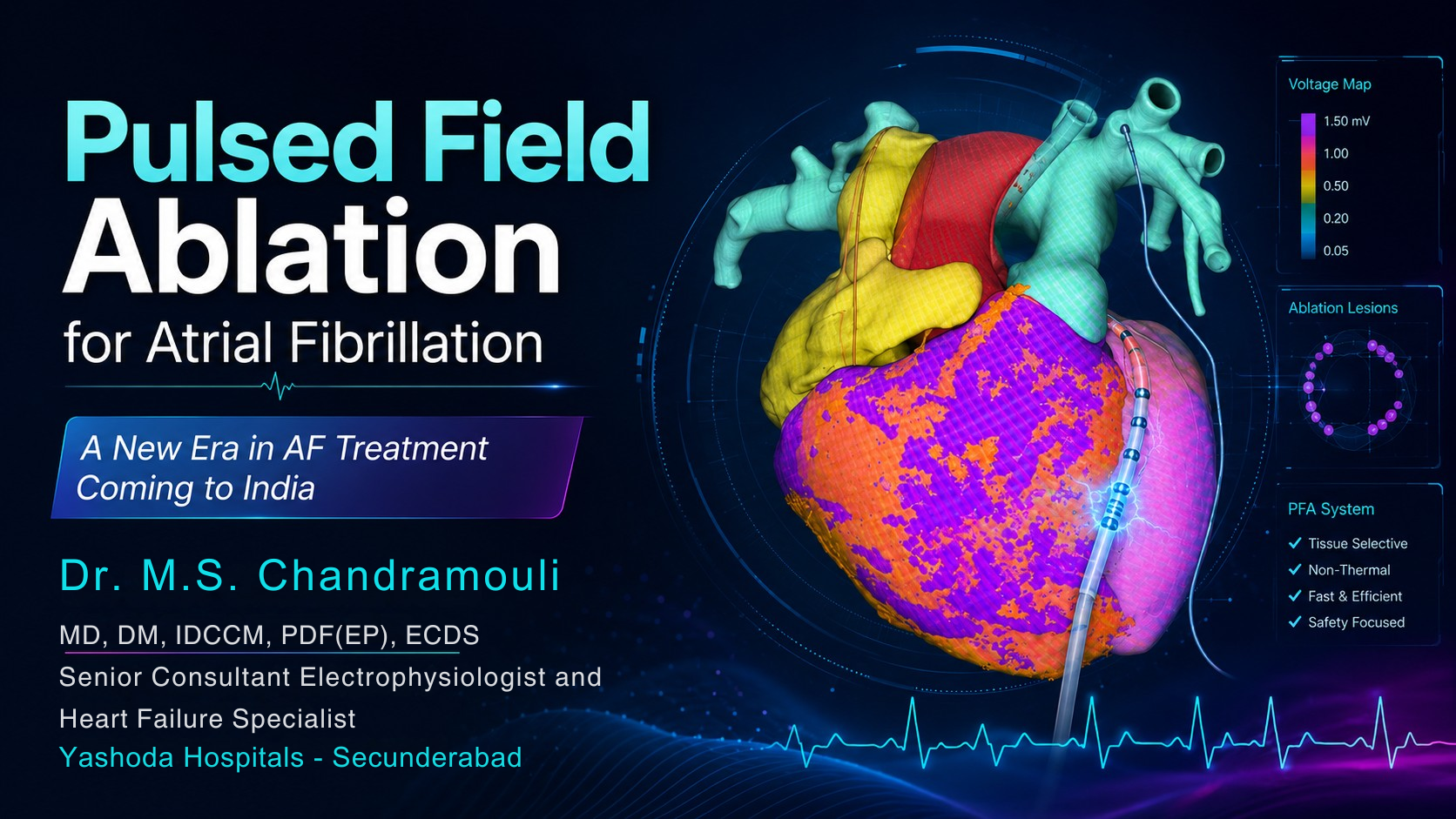
Advanced AF Treatment by Dr. M.S. Chandramouli, Yashoda Hospitals – Secunderabad
Atrial fibrillation, commonly known as AF or AFib, is one of the most common heart rhythm disorders. In this condition, the upper chambers of the heart beat in a fast, irregular, and uncoordinated way. Because of this irregular rhythm, the heart may not pump blood as efficiently as it should.
Many patients with AF experience symptoms such as palpitations, breathlessness, tiredness, dizziness, chest discomfort, reduced stamina, disturbed sleep, or anxiety due to sudden irregular heartbeats. In some patients, atrial fibrillation may not cause obvious symptoms but can still increase the risk of serious complications like stroke and heart failure.
For many years, AF has been treated with medicines, blood thinners, electrical cardioversion, and catheter ablation. Among these, catheter ablation has become an important treatment option for selected patients, especially when medicines are not effective or when symptoms continue to affect quality of life.
Now, the field of heart rhythm treatment is moving into a new era with Pulsed Field Ablation, also known as PFA.
Recently, an AF case was performed using PFA technology with advanced 3D electroanatomical mapping. This is an important step forward as this advanced technology is expected to be launched in India and may bring a new level of precision and safety to atrial fibrillation treatment.
What Is Pulsed Field Ablation?
Pulsed Field Ablation is a newer form of catheter ablation used for the treatment of atrial fibrillation. Traditional ablation technologies usually use heat or freezing energy to create controlled scars in the heart tissue that triggers abnormal rhythm.
PFA works differently.
Instead of using heat or cold, PFA uses short, high-energy electrical pulses to target specific heart muscle cells. This process is called irreversible electroporation. The aim is to treat the abnormal electrical areas responsible for AF while reducing damage to surrounding structures.
This non-thermal approach is one of the main reasons why PFA is being viewed as a major advancement in modern electrophysiology.
Why Is PFA Important in AF Treatment?
In many patients with atrial fibrillation, abnormal electrical signals start from the pulmonary veins. These veins bring oxygen-rich blood from the lungs into the left side of the heart. In AF ablation, one of the key goals is to electrically isolate these pulmonary veins so that abnormal signals do not trigger irregular heartbeats.
This is known as pulmonary vein isolation.
Traditional ablation methods have been effective, but they require extreme care because the left atrium is close to important structures such as the esophagus, nerves, and blood vessels. Since PFA uses a non-thermal energy source, it may reduce the risk of unwanted injury to nearby tissues in suitable cases.
This makes PFA a promising option for selected patients with atrial fibrillation.
How PFA Is Different from Traditional AF Ablation
The major difference between PFA and traditional ablation is the type of energy used.
In radiofrequency ablation, heat energy is used to create lesions.
In cryoablation, freezing energy is used.
In pulsed field ablation, electrical pulses are used.
Because PFA does not depend on heat or freezing, it may offer a more tissue-selective way of treating the heart muscle areas responsible for AF. This may help electrophysiologists perform pulmonary vein isolation with better procedural efficiency and potentially improved safety in selected patients.
For patients, this may mean a treatment approach that is more advanced, precise, and focused on reducing rhythm-related symptoms.
Role of 3D Mapping in PFA Procedures
Modern AF ablation is not just about delivering energy. It is about understanding the heart’s electrical system in detail.
The image from this AF case shows advanced 3D electroanatomical mapping being used during the procedure. This mapping system helps the electrophysiologist create a detailed view of the heart chamber, identify important electrical areas, guide catheter movement, and confirm the success of ablation.
In simple words, 3D mapping acts like a navigation system inside the heart.
This is especially useful in patients with complex rhythm problems, recurrent atrial fibrillation, persistent AF, enlarged heart chambers, or heart failure. It allows the doctor to plan treatment more accurately based on the patient’s heart anatomy and rhythm pattern.
Who May Need AF Ablation?
Not every patient with atrial fibrillation needs ablation. The treatment decision depends on the patient’s symptoms, age, type of AF, stroke risk, heart function, other medical conditions, and response to medicines.
AF ablation may be considered for patients who have:
Repeated episodes of palpitations or irregular heartbeat
Breathlessness or tiredness due to AF
Symptoms despite taking medicines
Side effects from rhythm-control medicines
AF affecting daily life or sleep
AF associated with heart failure
Recurrent hospital visits due to rhythm problems
Need for a rhythm-control strategy after specialist evaluation
The decision should always be made after consultation with a heart rhythm specialist.
Why PFA Is a Big Step for India
India has a growing number of patients with atrial fibrillation and other heart rhythm disorders. Many patients remain undiagnosed for years because symptoms like palpitations, tiredness, or breathlessness are often ignored or mistaken for stress, acidity, anxiety, or age-related weakness.
With advanced electrophysiology care, many patients can now be evaluated more accurately and treated with modern rhythm-control options.
The expected launch of PFA in India is an important development because it may give suitable patients access to a newer, non-thermal ablation technology. For hospitals with advanced electrophysiology programs, PFA represents a major step forward in the treatment of atrial fibrillation.
It may help bring faster, more precise, and potentially safer AF ablation procedures to selected patients.
PFA and Patient Safety
One of the key reasons PFA is gaining attention worldwide is its potential safety advantage. Since it does not use heat or freezing, it may reduce certain risks associated with thermal injury to nearby structures.
However, it is important to understand that PFA is not a risk-free procedure. Like any heart procedure, it requires proper patient selection, experienced electrophysiology expertise, advanced mapping support, and careful follow-up.
The success of AF treatment does not depend only on technology. It also depends on the doctor’s experience, the patient’s condition, the type of AF, and long-term rhythm management.
AF Treatment Is More Than Just Ablation
Atrial fibrillation management is not limited to one procedure. A complete AF care plan may include:
Rhythm assessment
Stroke risk evaluation
Blood thinner therapy when required
Rate or rhythm-control medicines
Lifestyle modification
Blood pressure control
Diabetes management
Sleep apnea screening
Weight management
Heart failure treatment if needed
Long-term rhythm monitoring
This complete approach is important because AF is often linked with other conditions such as high blood pressure, diabetes, obesity, sleep apnea, thyroid disorders, and heart failure.
Treating AF properly means treating the patient as a whole, not just the irregular heartbeat.
Advanced Heart Rhythm Care at Yashoda Hospitals, Secunderabad
Dr. M.S. Chandramouli is a Consultant Electrophysiologist and Heart Failure Specialist at Yashoda Hospitals, Secunderabad. His expertise includes advanced heart rhythm management, electrophysiology procedures, device therapy, atrial fibrillation treatment, and heart failure care.
With newer technologies like Pulsed Field Ablation entering clinical practice, patients with atrial fibrillation may soon have access to more advanced rhythm-control options in India.
The goal is not only to correct the rhythm but also to improve symptoms, protect heart function, reduce complications, and improve long-term quality of life.
When Should You Consult a Heart Rhythm Specialist?
You should consider consulting an electrophysiologist if you experience:
Fast or irregular heartbeat
Repeated palpitations
Unexplained breathlessness
Sudden tiredness or reduced stamina
Dizziness or fainting episodes
Chest discomfort with irregular rhythm
Known atrial fibrillation
AF despite medicines
Recurrent rhythm-related hospital visits
Heart failure with rhythm problems
Early diagnosis and timely treatment can make a major difference in outcomes.
Final Message for Patients
Atrial fibrillation is more than just an irregular heartbeat. It can affect energy levels, sleep, confidence, exercise capacity, and long-term heart health. In some patients, it can also increase the risk of stroke and heart failure.
Pulsed Field Ablation represents a promising new direction in AF treatment. As this technology prepares to launch in India, it brings hope for more precise, efficient, and advanced rhythm care for suitable patients.
If you or your loved one has recurrent palpitations, irregular heartbeat, breathlessness, unexplained fatigue, or diagnosed atrial fibrillation, it is important to consult a heart rhythm specialist for proper evaluation.
Dr. M.S. Chandramouli
MD, DM, IDCCM, PDF(EP), ECDS
Consultant Electrophysiologist and Heart Failure Specialist
Yashoda Hospitals – Secunderabad