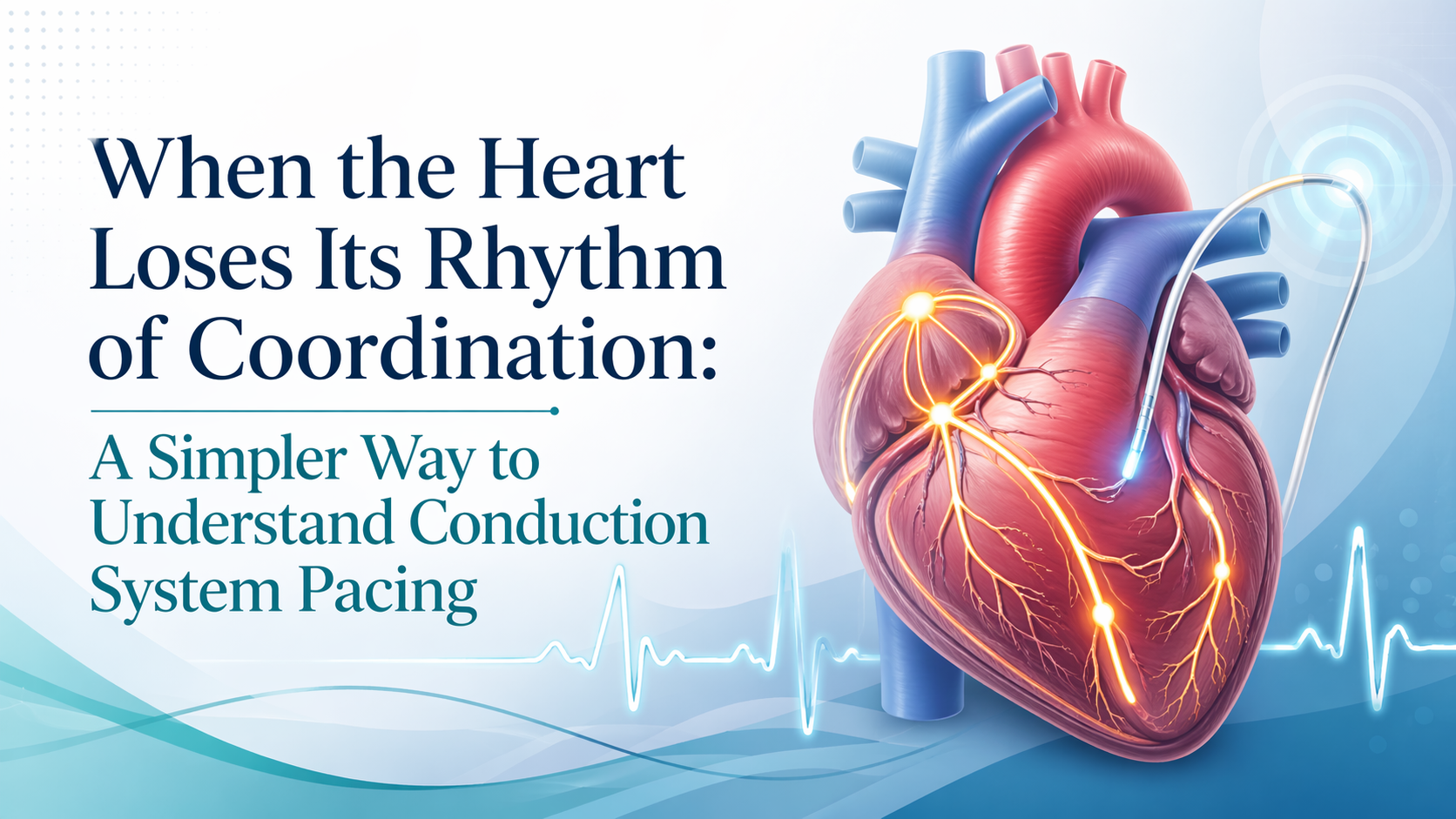
When people hear the word pacemaker, they usually think of a device that helps the heart beat when the rhythm is too slow. But modern pacing is not only about keeping the heart beating. It is also about helping the heart beat in a more natural and coordinated way. This is where conduction system pacing becomes important. By working closer to the heart’s own electrical pathway, this approach aims to preserve a more physiologic rhythm. For patients who need pacing support, understanding this concept can help them better discuss treatment options with their heart rhythm specialist.
When most people think about the heart, they think about strength or speed. Is the heart pumping well? Is the heartbeat too fast or too slow? But there is another part of heart function that matters just as much: coordination.
Your heart is not just a muscle. It is also an electrical system. Tiny electrical signals travel through a specialized pathway inside the heart and tell each chamber when to contract. This timing is what allows the heartbeat to feel smooth, efficient, and synchronized. When that electrical coordination is disturbed, the heart may still beat, but it may not beat in the most natural way.
A simple way to understand this is to imagine an orchestra. It is not enough for every musician to play. They must play at the right moment. If the timing is off, the music continues, but the harmony is lost. The heart works in a similar way. A healthy heartbeat depends not only on whether impulses are generated, but also on how those impulses travel through the heart’s natural wiring system.
Why coordination matters in the heart
The heart’s natural conduction system includes structures that carry electrical impulses in a precise sequence so the upper and lower chambers work together efficiently. That sequence is what helps blood move properly through the heart and out to the body.
When conduction is delayed or blocked, the signal may have to take a slower or less direct route. One part of the heart may contract slightly later than the other. That may sound small, but in the heart, even small timing changes can matter.
Where pacemakers come in
Pacemakers are used when the heart’s natural pacemaker or conduction system is not working properly. They help maintain an adequate heart rate and rhythm when the heartbeat is too slow or when electrical signals are not traveling the way they should. For many patients, pacemakers are life-improving and sometimes lifesaving devices.
Traditionally, pacing has often focused on making sure the heart beats reliably. That remains extremely important. But in recent years, cardiology has moved toward a more refined question: can pacing do more than simply produce a heartbeat? Can it help the heart beat in a way that is closer to its own natural electrical pattern? That is where conduction system pacing comes in.
What is conduction system pacing?
Conduction system pacing is a form of pacing that tries to engage the heart’s intrinsic electrical system more directly. The two main approaches are His bundle pacing and left bundle branch area pacing. Rather than pacing from a location that may activate the ventricles less naturally, these approaches aim to preserve or restore a more physiologic pattern of ventricular activation.
In simpler words, it is an attempt to guide the heartbeat through a route that is closer to the one nature designed.
This does not mean conduction system pacing is automatically the right choice for every patient. It means that, for selected patients, doctors may consider whether a more physiologic pacing strategy could be beneficial, especially when a person is expected to need a significant amount of ventricular pacing.
Why this approach is getting attention
One reason conduction system pacing is receiving so much attention is that it aligns with a simple principle: the heart usually works best when its chambers are activated in a coordinated way.
For patients and families, the most important takeaway is not the technical terminology. It is this: modern pacing is increasingly trying to support not just the rate of the heartbeat, but also its quality of coordination. That shift makes conduction system pacing an important concept in contemporary rhythm care.
A softer way to think about it
If the heart is like an orchestra, then traditional pacing may ensure the music does not stop. Conduction system pacing tries, whenever appropriate, to help the orchestra play more in sync.
That is why this concept matters. Many patients are familiar with the idea of “getting a pacemaker,” but fewer know that there are now different pacing strategies, and that some are designed to work closer to the heart’s own wiring. For the right patient, that may support a rhythm that is more natural and more coordinated.
The bottom line
Conduction system pacing represents a more physiologic way of thinking about pacing. It does not replace careful patient selection, and it is not a one-size-fits-all solution. But it reflects an important evolution in cardiac care: moving from “make the heart beat” toward “help the heart beat in a more natural way.”
For patients, that message is reassuring. The goal is not only to keep the rhythm going, but also to respect the heart’s built-in design as much as possible. And in many areas of medicine, that is where real progress begins.
FAQs
1. Is conduction system pacing the same as a regular pacemaker?
Not exactly. A pacemaker is the device. Conduction system pacing describes where and how the pacing lead stimulates the heart. It aims to engage the heart’s natural electrical pathway more directly, typically through His bundle pacing or left bundle branch area pacing.
2. Why is the heart’s electrical pathway so important?
Because the heartbeat depends on electrical signals traveling in the correct sequence. That sequence helps the chambers contract in a coordinated way so blood is pumped efficiently.
3. Is conduction system pacing right for everyone who needs a pacemaker?
No. Treatment choice depends on the patient’s condition, anatomy, conduction problem, heart function, and how much ventricular pacing is expected. It may be considered in selected patients, especially when a significant pacing burden is anticipated.
4. What are the main types of conduction system pacing?
The two main types are His bundle pacing and left bundle branch area pacing.
5. Why are doctors increasingly interested in this approach?
Because it may preserve or restore a more physiologic pattern of ventricular activation than some traditional pacing strategies. That is why it has become an important part of current discussions on cardiac physiologic pacing.
6. Should patients ask their doctor about it?
Yes. If a pacemaker is being discussed, it is reasonable to ask what pacing strategy is planned and whether conduction system pacing is relevant in that specific case. The answer will depend on the individual patient, not on a general rule.
Dr. M.S. Chandramouli
Consultant Electrophysiologist and Heart Failure Specialist
Yashoda Hospitals – Secunderabad