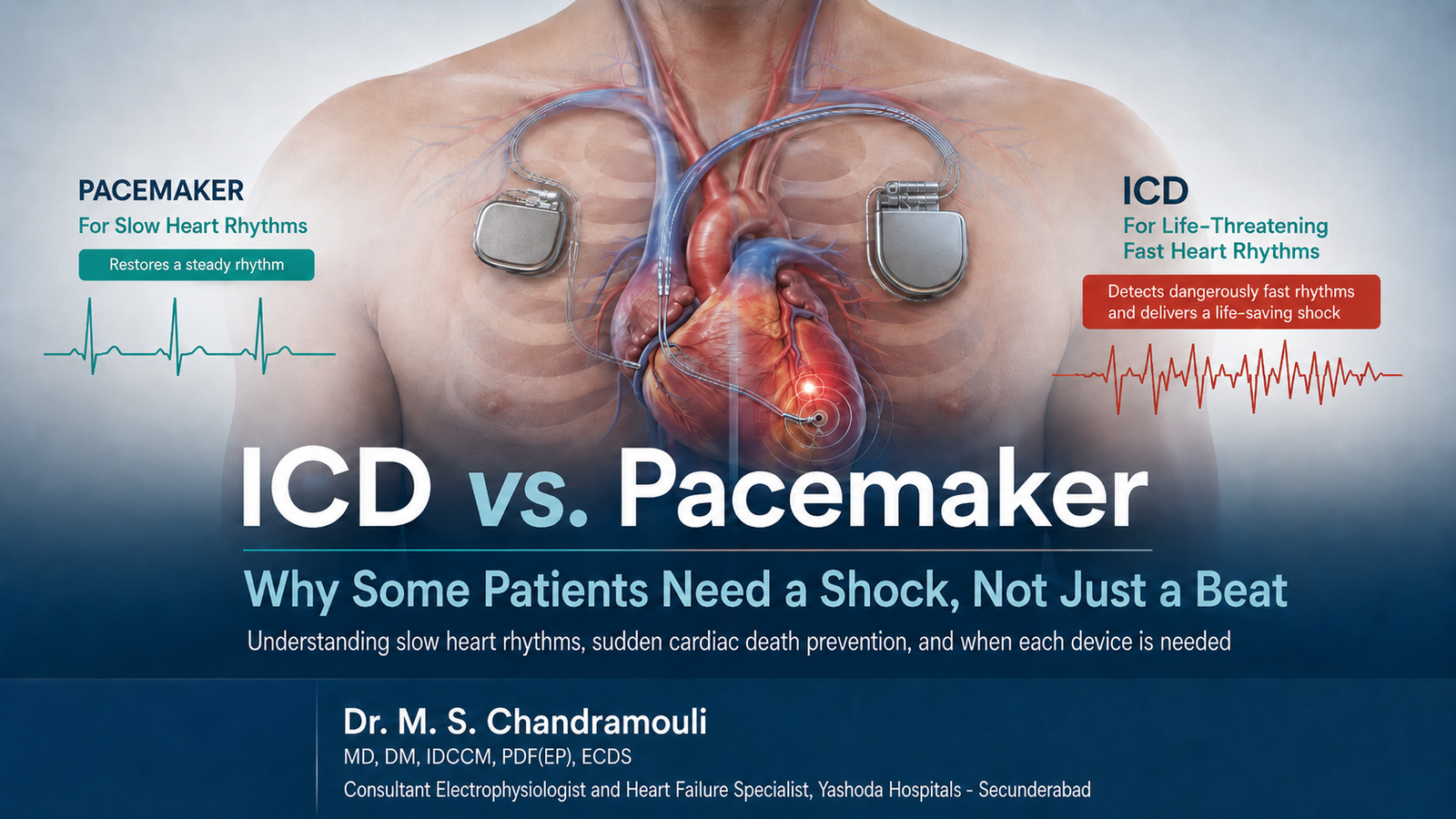
Many patients use the words pacemaker and ICD interchangeably. Although both are small electronic devices implanted to manage heart rhythm problems, they are designed for very different situations.
A pacemaker primarily supports a heart that is beating too slowly or whose electrical signals are not travelling properly. An implantable cardioverter-defibrillator, or ICD, is designed to recognise and treat certain dangerously fast heart rhythms that could cause sudden cardiac arrest.
The simplest way to understand the difference is:
A pacemaker prevents the heart from going too slow. An ICD protects against certain life-threatening fast rhythms—and can deliver a shock when necessary.
However, the decision is not always this simple. Some ICDs can also function as pacemakers, and certain people with heart failure may require a specialised device that combines pacing, resynchronisation and defibrillation.
Pacemaker vs. ICD at a Glance
| Feature | Pacemaker | ICD |
|---|---|---|
| Main purpose | Prevents the heart from beating too slowly | Detects and treats life-threatening fast ventricular rhythms |
| Commonly treats | Bradycardia, sinus-node dysfunction and heart block | Ventricular tachycardia and ventricular fibrillation |
| Type of therapy | Gentle, low-energy pacing impulses | Anti-tachycardia pacing, high-energy shocks and backup pacing |
| Can deliver a shock? | No | Yes |
| Can provide pacing? | Yes | Most ICDs can also provide backup pacing |
| Main risk being addressed | Dizziness, fatigue, breathlessness or fainting caused by a slow heartbeat | Sudden cardiac arrest and sudden cardiac death |
| Is ejection fraction important? | Usually not the main deciding factor | Often important in selected heart-failure patients |
| Leadless option available? | Yes, for carefully selected pacing needs | A leadless pacemaker does not replace an ICD |
A traditional pacemaker produces small electrical impulses that help the heart maintain an appropriate rhythm. An ICD continuously monitors the heart and may provide gentle pacing, rapid anti-tachycardia pacing or a stronger shock depending on the rhythm detected.
First, Understand the Heart’s Electrical System
The heartbeat begins with an electrical signal generated by the sinus node, the heart’s natural pacemaker. The signal travels through the upper chambers, reaches the atrioventricular node and then passes into the lower pumping chambers.
Problems can occur when:
- The signal is generated too slowly.
- The signal is blocked while travelling through the heart.
- Abnormal electrical circuits make the lower chambers beat dangerously fast.
- Damaged heart muscle creates areas from which serious rhythms can arise.
The type of electrical problem determines whether a patient needs a pacemaker, an ICD, medication, catheter ablation or a combination of treatments.
What Is a Pacemaker?
A pacemaker is a small battery-operated device that monitors the heart rhythm and sends gentle electrical impulses when the heartbeat becomes too slow.
A conventional pacemaker usually consists of:
- A pulse generator placed beneath the skin near the collarbone.
- One or more leads that travel through a vein into the heart.
- Electrodes that sense the heartbeat and deliver pacing impulses.
Newer leadless pacemakers combine the generator and electrode in one small device placed directly inside the heart through a catheter. Leadless devices can be valuable for selected patients, but they do not provide every type of pacing therapy.
When Might a Pacemaker Be Recommended?
A pacemaker may be considered when a slow or unreliable heartbeat is causing symptoms or creating a significant risk. Common situations include:
Symptomatic bradycardia
Bradycardia means that the heart is beating more slowly than appropriate for the person’s needs. Some physically fit people naturally have a low resting heart rate and require no treatment. A pacemaker is generally considered when the slow rhythm is clinically significant and associated with symptoms.
Possible symptoms include:
- Dizziness or light-headedness
- Unexplained fatigue
- Shortness of breath
- Reduced exercise capacity
- Confusion
- Near-fainting or fainting
Sinus-node dysfunction
The sinus node may fail to generate signals consistently. The heartbeat may remain too slow, pause unexpectedly or alternate between slow and fast rhythms.
Heart block
In atrioventricular heart block, electrical signals from the upper chambers may be delayed or prevented from reaching the lower chambers. Advanced heart block can produce a dangerously slow pulse, fainting or, in severe cases, cardiac arrest.
Bradycardia caused by necessary medication
Some medications used to control atrial fibrillation or other cardiac conditions can slow the heart rate. When the medication remains necessary but causes clinically significant bradycardia, pacing may occasionally be considered.
Modern guidelines emphasise matching documented rhythm abnormalities with the patient’s symptoms and using shared decision-making before pacemaker implantation.
What Does Pacemaker Pacing Feel Like?
Most people do not feel ordinary pacing impulses. These impulses use very small amounts of energy and are intended to imitate the heart’s natural electrical activity.
A pacemaker does not deliver the kind of high-energy shock associated with a defibrillator.
What Is an ICD?
An ICD, or implantable cardioverter-defibrillator, is a device designed to protect a person from certain life-threatening rhythms arising from the ventricles, the heart’s lower chambers.
These rhythms include:
Ventricular tachycardia
Ventricular tachycardia, or VT, is an abnormally fast rhythm originating in the ventricles. Some episodes may be tolerated briefly, while others cause severe dizziness, loss of consciousness or cardiac arrest.
Ventricular fibrillation
Ventricular fibrillation, or VF, is a chaotic electrical rhythm in which the ventricles quiver rather than pump blood effectively. Without immediate correction, VF causes sudden cardiac arrest.
An ICD monitors the heart continuously. When it detects a dangerous rhythm, it can respond within seconds.
How Does an ICD Stop a Dangerous Rhythm?
An ICD may use different levels of treatment.
1. Anti-tachycardia pacing
For some episodes of ventricular tachycardia, the ICD first delivers a rapid sequence of low-energy pacing impulses. This is called anti-tachycardia pacing, or ATP.
ATP attempts to interrupt the abnormal electrical circuit and restore a normal rhythm. Many patients do not feel ATP, although some may notice palpitations or a brief change in their heartbeat.
2. Cardioversion or defibrillation shock
When ATP is unsuccessful, inappropriate for the detected rhythm or the rhythm is immediately dangerous, the ICD delivers a stronger electrical shock to reset the heart.
3. Backup pacing
Most transvenous ICDs can also provide pacemaker support if the heart rate becomes too slow. This is why an ICD can often perform pacemaker functions, while an ordinary pacemaker cannot perform the defibrillation functions of an ICD.
Why Would Someone Need an ICD?
ICDs are generally used in two broad situations: secondary prevention and primary prevention.
Secondary Prevention: A Dangerous Rhythm Has Already Occurred
An ICD may be recommended after a person has:
- Survived sudden cardiac arrest caused by VT or VF
- Experienced sustained ventricular tachycardia producing severe symptoms or haemodynamic instability
- Had a serious ventricular arrhythmia without a clearly reversible cause
Doctors first investigate whether the rhythm was caused by a temporary correctable problem, such as a major electrolyte abnormality, acute drug toxicity or another reversible trigger. An ICD may not be necessary when the risk disappears after the underlying cause is fully corrected.
For people who remain at risk of recurrent VT or VF, an ICD acts as an internal emergency-response system.
Primary Prevention: Preventing the First Cardiac Arrest
Some patients have never experienced cardiac arrest but have a sufficiently high predicted risk of a dangerous ventricular arrhythmia.
This group may include selected people with:
- Heart failure and a severely reduced ejection fraction
- Previous heart attack with extensive heart-muscle damage
- Dilated cardiomyopathy
- Hypertrophic cardiomyopathy
- Arrhythmogenic cardiomyopathy
- Cardiac sarcoidosis
- Long QT syndrome
- Brugada syndrome
- Certain inherited or congenital cardiac conditions
The decision is based on the complete clinical picture—not on one report or one number.
What Does Ejection Fraction Have to Do With an ICD?
Left ventricular ejection fraction, or LVEF, estimates the percentage of blood pumped out of the left ventricle with each contraction.
A normal or near-normal ejection fraction does not guarantee that a person has no rhythm risk. Similarly, a low ejection fraction does not automatically mean that every patient needs an ICD.
However, a significantly reduced LVEF is an important marker of sudden-death risk in selected people with heart failure.
One major guideline pathway recommends primary-prevention ICD therapy for appropriately selected patients with ischaemic or non-ischaemic cardiomyopathy who have:
- LVEF of 35% or less
- Persistent heart-failure symptoms, commonly NYHA class II or III
- Guideline-directed medical treatment
- A reasonable expectation of meaningful survival for more than one year
For selected people who have had a heart attack, have few or no heart-failure symptoms and have an LVEF of 30% or less, an ICD may also be recommended after the appropriate waiting period.
Why Doctors Usually Wait Before Deciding
Ejection fraction can improve after:
- Starting and optimising heart-failure medications
- Treating blocked coronary arteries
- Recovering from a recent heart attack
- Controlling a persistent fast rhythm
- Treating myocarditis or another reversible cause
- Correcting severe valve disease in appropriate cases
Therefore, preventive ICD implantation is generally not decided from an ejection-fraction reading obtained immediately after a heart attack or at the beginning of heart-failure treatment.
Guidelines commonly require reassessment after adequate medical therapy. For post-heart-attack patients, preventive implantation is generally avoided during the first 40 days, except when another clear indication exists. Following coronary revascularisation, an additional recovery and reassessment period may be appropriate.
Ejection Fraction Is Not the Whole Decision
An electrophysiologist may also consider:
- The cause of the heart-muscle weakness
- Cardiac MRI evidence of scar tissue
- Previous VT or unexplained fainting
- ECG and ambulatory-monitor findings
- Family history of sudden cardiac death
- Genetic test results
- Kidney, lung or neurological disease
- The likelihood of non-arrhythmic death
- Functional status and frailty
- Expected quality and length of life
- The patient’s values and preferences
A person with an LVEF of 30% may not necessarily benefit from an ICD if severe non-cardiac illness limits life expectancy. Conversely, a person with an ejection fraction above 35% may still need an ICD because of a previous cardiac arrest, sustained VT or a high-risk inherited condition.
Pacemaker, ICD, CRT-P or CRT-D: Why the Names Become Confusing
Some patients with heart failure have electrical delay between the two ventricles. As a result, the chambers do not contract together efficiently.
Cardiac resynchronisation therapy, or CRT, stimulates the ventricles in a coordinated way.
There are two broad forms:
CRT-P
CRT-P provides resynchronisation and pacemaker therapy but does not provide defibrillator shocks.
CRT-D
CRT-D combines:
- Cardiac resynchronisation
- Pacemaker functions
- Anti-tachycardia pacing
- Defibrillation shocks
Whether a patient needs CRT-P or CRT-D depends on the ECG pattern, QRS duration, ejection fraction, symptoms, rhythm risk, general health and expected benefit. Guidelines identify selected symptomatic patients with LVEF of 35% or less and significant electrical delay—particularly left bundle branch block with a wide QRS—as potential candidates for CRT.
What Does an ICD Shock Feel Like?
Experiences vary.
Some people describe an ICD shock as:
- A sudden heavy thump
- A forceful kick to the chest
- A brief jolt through the body
- An unexpected sensation that lasts only a second or two
A person who loses consciousness before the shock may not remember feeling it. Others remain conscious and experience the shock as painful or frightening. Hospital patient guidance commonly describes it as a hard blow, kick or strong thump to the chest.
It is important to remember that the shock is delivered because the ICD has identified a rhythm that may be immediately dangerous. The purpose of that brief intervention is to restore an effective heartbeat.
Will Everyone With an ICD Receive a Shock?
No. Many people live with an ICD for years without ever receiving a shock.
An ICD may also terminate some ventricular tachycardias using painless or minimally noticeable ATP before a shock becomes necessary.
Modern ICD programming is designed to reduce avoidable treatment by:
- Allowing certain fast rhythms time to stop naturally
- Distinguishing ventricular rhythms from atrial arrhythmias
- Using ATP before a shock when appropriate
- Setting personalised detection zones
Despite these safeguards, inappropriate shocks can occasionally occur. Possible causes include atrial fibrillation with a rapid rate, lead problems, electrical noise or device-programming issues. Any shock should therefore be reviewed through device interrogation.
What Should You Do After an ICD Shock?
Your electrophysiology team should provide an individual action plan. A commonly used approach is:
One shock and you feel well
- Sit or lie down safely.
- Note what you were doing and any symptoms you experienced.
- Contact your ICD or electrophysiology clinic promptly.
- Send a remote-monitor transmission when instructed.
- Do not assume that everything is fine simply because you feel normal.
One shock with chest pain, breathlessness, fainting or persistent illness
Seek emergency medical care immediately.
Two or more shocks close together
Call emergency services immediately, even if you remain conscious.
Repeated shocks may indicate an ongoing electrical emergency sometimes called an electrical storm. Device recordings are required to determine whether the therapy was appropriate and whether medication, ablation or device-programming changes are needed.
Do not place a magnet over an ICD unless your treating team or emergency professionals have specifically instructed you to do so.
Can You Drive After an Appropriate ICD Shock?
Driving restrictions after ICD implantation or therapy depend on:
- Why the ICD was implanted
- Whether the treatment was appropriate
- Whether the rhythm caused fainting or loss of control
- Whether the patient drives privately or commercially
- Local licensing regulations
- The treating electrophysiologist’s assessment
After an appropriate ICD shock for VT or VF, patients should stop driving and contact their electrophysiologist before returning to the road.
Restrictions differ significantly between countries. For example, current UK guidance generally requires private drivers to stop driving for six months after the most recent appropriate ICD therapy, while commercial-vehicle rules are considerably stricter. These timelines should not be applied automatically in India or another jurisdiction.
The safest advice is:
Do not resume driving after an ICD shock until the device has been reviewed and your electrophysiologist has confirmed that it is safe and consistent with local rules.
A shock may successfully correct the rhythm, but the arrhythmia itself may have caused dizziness, fainting or impaired awareness before treatment was delivered.
The Emotional Side of Living With an ICD
An ICD can provide reassurance because it continuously protects against specific dangerous rhythms. At the same time, it is normal for patients to experience mixed emotions.
Common concerns include:
- “When will the device shock me?”
- “Will exercise trigger it?”
- “Can I travel safely?”
- “What happens if I am alone?”
- “Will a shock hurt?”
- “Can I return to work?”
- “Will people notice the device?”
- “Is my heart condition getting worse?”
Anxiety, low mood and symptoms of post-traumatic stress may occur, particularly after cardiac arrest, fainting or repeated shocks. These reactions should not be dismissed as weakness. The American Heart Association advises patients to discuss emotional distress openly with their healthcare team because psychological health is an important part of recovery.
Helpful steps may include:
- Understanding exactly why the device was recommended
- Receiving a written shock-response plan
- Learning how remote monitoring works
- Discussing safe exercise with the medical team
- Involving family members in device education
- Speaking with another ICD patient through a support group
- Seeking counselling when anxiety affects sleep, work or daily activity
- Discussing recurrent shocks with an electrophysiologist, as medication, ablation or programming changes may help
The goal is not merely to implant the device. It is to help the patient return to a meaningful and confident life.
Does a Leadless Pacemaker Replace an ICD?
No.
A leadless pacemaker can provide pacing for selected slow-heart-rhythm problems. It does not deliver a defibrillation shock for ventricular fibrillation and should not be viewed as a replacement for an ICD.
A patient who requires protection from sudden cardiac death may need:
- A transvenous ICD
- A subcutaneous ICD
- A CRT-D device
- Another specialised system based on the need for pacing and defibrillation
Device selection should consider age, anatomy, infection risk, vascular access, pacing requirements and the likelihood of future therapy.
Questions to Ask Before Receiving a Pacemaker or ICD
Before implantation, patients may wish to ask:
- What exact rhythm problem do I have?
- Is the purpose of this device symptom relief, sudden-death prevention or both?
- Why do you recommend a pacemaker rather than an ICD?
- Does my ejection fraction affect the recommendation?
- Could my heart function improve with medication before a final decision?
- Do I need single-chamber, dual-chamber or biventricular pacing?
- Would a leadless pacemaker be suitable?
- Would a subcutaneous ICD be an option?
- How likely am I to need pacing as well as defibrillation?
- What should I do if I receive a shock?
- When can I drive, work, exercise and travel?
- How will the device be monitored?
- What are the risks of infection, bleeding, lead complications and inappropriate therapy?
- What happens when the battery reaches the end of its service life?
- How does this device fit with my long-term health goals?
Frequently Asked Questions
Is an ICD just a stronger pacemaker?
Not exactly. Most ICDs include backup pacing, but their defining purpose is to recognise and terminate certain life-threatening ventricular rhythms. A standard pacemaker cannot deliver defibrillation therapy.
Can a pacemaker prevent sudden cardiac death?
A pacemaker can prevent serious consequences caused by extreme bradycardia or heart block. However, it cannot terminate ventricular fibrillation in the way an ICD can.
Does an ejection fraction below 35% always mean I need an ICD?
No. The cause of the low EF, duration of medical treatment, time since a heart attack or revascularisation, symptoms, competing illnesses, rhythm history and expected survival must all be considered.
Can someone with a normal ejection fraction need an ICD?
Yes. Some patients with previous cardiac arrest, sustained ventricular tachycardia or specific inherited and structural heart diseases may need an ICD despite having a relatively preserved ejection fraction.
Can an ICD shock a person unnecessarily?
Inappropriate shocks are possible but have become less frequent with improved detection algorithms and personalised programming. Any shock should be reviewed by the device clinic.
Can someone touch me while my ICD delivers a shock?
Yes. The person may notice a brief tingling sensation, but the shock does not pose a significant danger to someone touching you.
Can an ICD cure heart failure?
No. An ICD does not strengthen the heart muscle or remove blocked arteries. It reduces the risk of death from selected dangerous rhythms. Heart-failure medication and treatment of the underlying cause remain essential.
Can catheter ablation eliminate the need for an ICD?
Ablation can reduce recurrent ventricular tachycardia and ICD therapies in selected patients. However, it does not automatically remove the underlying risk of sudden cardiac death. The decision to implant, retain or replace an ICD must be individualised.
Will I know when the ICD battery is running low?
ICDs are checked regularly in the clinic or through remote monitoring. Battery depletion is usually detected well before the device stops functioning, allowing planned generator replacement.
The Most Important Difference
A pacemaker and an ICD may look similar, but they answer different clinical questions.
- Is the heart beating too slowly or failing to conduct its electrical signals?
A pacemaker may be required. - Is the patient at meaningful risk of ventricular tachycardia, ventricular fibrillation or sudden cardiac death?
An ICD may be required. - Does the patient have heart failure with delayed ventricular activation and an elevated rhythm risk?
A CRT-D may be appropriate.
The correct device cannot be selected from symptoms or ejection fraction alone. It requires a careful evaluation of the heart rhythm, heart structure, underlying disease, response to treatment and the patient’s overall goals.
Consult an Electrophysiologist
For an individual assessment of bradycardia, heart block, fainting, ventricular arrhythmias, reduced ejection fraction or device therapy, consult:
Dr. M. S. Chandramouli
MD, DM, IDCCM, PDF (EP), ECDS
Consultant Electrophysiologist and Heart Failure Specialist
Yashoda Hospitals, Secunderabad
An electrophysiology consultation can help determine whether you need a pacemaker, ICD, CRT device, catheter ablation, medication or continued monitoring.
Medical disclaimer: This article is intended for patient education and does not replace an examination, diagnosis or personalised treatment recommendation. Seek urgent medical care for fainting, severe chest pain, sudden breathlessness, sustained palpitations, collapse or multiple ICD shocks.