A 22-year-old with hypertrophic cardiomyopathy or an inherited electrical heart condition may need protection from sudden cardiac death for several decades.
For such a young patient, the concern is not only whether an implantable cardioverter-defibrillator can treat a dangerous heart rhythm. The long-term implications of placing a lead inside a blood vessel and the heart must also be considered.
This is where a subcutaneous implantable cardioverter-defibrillator, commonly called an S-ICD, may offer an alternative.
Unlike a conventional transvenous ICD, an S-ICD does not have a lead travelling through a vein into the heart. The generator and electrode are placed under the skin, leaving the heart and blood vessels untouched.
This can be particularly valuable for selected young patients who require protection from life-threatening ventricular arrhythmias but do not need regular pacing.
However, an S-ICD is not automatically the best option for every young patient. The right device depends on the underlying heart condition, type of arrhythmia, need for pacing, anatomy, lifestyle and expected long-term treatment requirements.
What Is an Implantable Cardioverter-Defibrillator?
An implantable cardioverter-defibrillator, or ICD, is a cardiac device designed to recognise and treat certain dangerous heart rhythms arising from the ventricles.
These rhythms include:
- Ventricular tachycardia
- Ventricular fibrillation
- Selected life-threatening ventricular arrhythmias
When an ICD detects a dangerous rhythm, it can deliver treatment to restore a safer heartbeat.
Depending on the type of device, treatment may include:
- Anti-tachycardia pacing
- A high-energy electrical shock
- Backup pacing for a slow heartbeat
- Cardiac resynchronisation therapy
An ICD does not prevent every arrhythmia from occurring. Instead, it continuously monitors the heartbeat and provides treatment when it recognises a potentially dangerous rhythm.
Why Might a Young Person Need an ICD?
A young adult may appear completely healthy and still have an increased risk of a dangerous ventricular arrhythmia.
An ICD may be considered in selected patients with:
- Hypertrophic cardiomyopathy
- Arrhythmogenic cardiomyopathy
- Long QT syndrome
- Brugada syndrome
- Catecholaminergic polymorphic ventricular tachycardia
- Previous unexplained cardiac arrest
- Previous ventricular fibrillation
- Sustained ventricular tachycardia
- Certain congenital heart conditions
- Significant heart-muscle weakness
- A strong inherited risk of sudden cardiac death
Having one of these conditions does not automatically mean that an ICD is required. The decision is made after an individual risk assessment.
For a patient in their twenties or thirties, device selection is especially important because they may live with an ICD for many years and undergo several generator replacements during their lifetime.
S-ICD vs Traditional Transvenous ICD
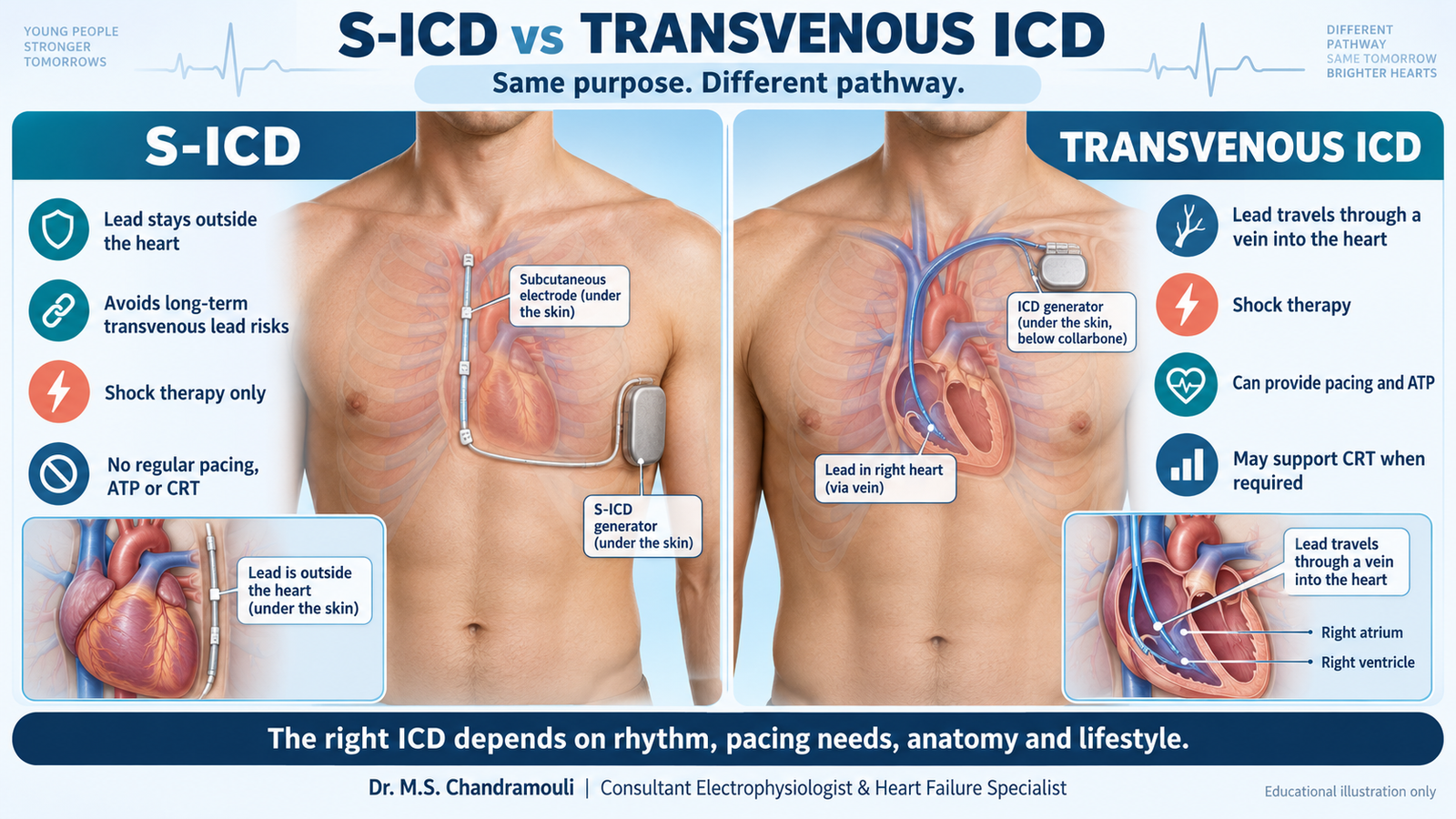
The fundamental difference is the location of the electrode or lead.
Traditional Transvenous ICD
A conventional or transvenous ICD normally has:
- A generator placed beneath the skin, usually below the collarbone
- One or more leads passed through a vein
- A lead positioned inside the right side of the heart
Because the lead is inside the heart, a transvenous ICD can provide more than shock therapy.
Depending on the device, it may offer:
- Anti-tachycardia pacing
- Backup pacing for bradycardia
- Continuous pacing when necessary
- Cardiac resynchronisation therapy
Subcutaneous ICD
An S-ICD normally has:
- A generator placed under the skin at the side of the chest
- An electrode positioned beneath the skin alongside the breastbone
- No lead travelling through a vein
- No lead placed inside the heart
The S-ICD continuously monitors the heartbeat and can deliver a shock for certain life-threatening ventricular rhythms.
Its principal limitation is that it cannot provide the same ongoing pacing functions as a conventional transvenous system.
Place the “S-ICD vs Transvenous ICD” comparison image here.
Quick Comparison
| Feature | S-ICD | Transvenous ICD |
|---|---|---|
| Lead location | Under the skin and outside the heart | Through a vein and inside the heart |
| Defibrillation shocks | Yes | Yes |
| Anti-tachycardia pacing | No | Available with appropriate devices |
| Regular bradycardia pacing | No | Yes, when required |
| CRT support | No | Available with CRT-D systems |
| Intravascular lead risk | Avoided | Present |
| Lead-related bloodstream infection risk | Reduced because no lead enters the bloodstream | Lead may be involved in systemic infection |
| Suitable for young patients | Often considered when pacing is not needed | Appropriate when pacing or ATP is needed |
| Generator position | Side of the chest | Commonly below the collarbone |
| Device visibility | Can be more noticeable because of its position and size | Usually smaller and placed in the upper chest |
Why an S-ICD May Be Attractive for Young Adults
1. No Lead Inside the Heart
The biggest difference is that the S-ICD electrode remains outside the heart and bloodstream.
A transvenous lead is exposed to the movement of the heart, blood flow and bending forces between the collarbone and first rib. Over many years, leads can develop problems such as insulation damage or conductor failure.
An S-ICD avoids the long-term risks specifically associated with an intracardiac transvenous lead. It does not mean that an S-ICD can never develop an electrode or device problem, but it removes the need for a lead inside the vascular system.
2. Preserving the Veins
Young patients may require device therapy for many decades. Preserving venous access can therefore be valuable.
A transvenous lead can sometimes contribute to narrowing or obstruction of the vein through which it passes. This may become relevant if additional leads or future procedures are required.
Because the S-ICD system remains outside the veins, it preserves the vascular pathway.
3. Lower Exposure to Certain Lead-Related Infections
An infection involving a transvenous ICD lead can extend into the bloodstream or heart. Treating such an infection may require removal of the entire system, including the intracardiac lead.
An S-ICD does not eliminate infection risk. The skin incision, generator pocket and subcutaneous electrode can still become infected. However, the absence of a lead inside the bloodstream avoids certain serious complications associated with transvenous lead infection.
4. Avoiding Intracardiac Lead Extraction
Removing an old transvenous lead can become more complex as scar tissue develops around it.
Young patients may require lead revision or replacement during their lifetime. Avoiding a transvenous lead can reduce exposure to future intracardiac lead-extraction procedures.
5. Useful When Venous Access Is Difficult
An S-ICD may also be considered when:
- The veins are blocked or narrowed
- A previous device infection occurred
- The patient has congenital heart anatomy that makes venous access difficult
- Preserving vascular access is particularly important
- A long-term dialysis access site must be protected
Why an S-ICD Is Not Suitable for Everyone
The absence of an intracardiac lead creates several advantages, but it also limits what the device can do.
It Cannot Provide Regular Pacing
An S-ICD is generally not suitable for a patient who needs ongoing pacing because of:
- Symptomatic bradycardia
- Sinus-node dysfunction
- Advanced heart block
- Significant pauses in the heartbeat
A transvenous system may be more appropriate when regular pacing is required.
It Cannot Provide Anti-Tachycardia Pacing
Some forms of ventricular tachycardia can be terminated using a series of rapid, low-energy pacing impulses. This is known as anti-tachycardia pacing, or ATP.
ATP can sometimes stop ventricular tachycardia without requiring a shock.
A standard S-ICD cannot deliver ATP. If a patient is likely to experience recurrent ventricular tachycardia that may respond to ATP, a transvenous ICD may be preferred.
It Cannot Provide Cardiac Resynchronisation Therapy
Some patients with heart failure need cardiac resynchronisation therapy to coordinate the contraction of the ventricles.
An S-ICD cannot provide CRT. A CRT-defibrillator may be recommended when both resynchronisation and defibrillation are required.
Current guideline-based selection therefore generally considers an S-ICD when an ICD is indicated and the patient does not require bradycardia pacing, ATP or CRT. ESC ventricular-arrhythmia guidance
The Generator May Be More Noticeable
An S-ICD generator is generally larger than a conventional ICD generator and is positioned at the side of the chest, often beneath or between muscle layers.
Some thin patients may notice the device more prominently. The position should be discussed before implantation, particularly for young adults concerned about comfort, appearance, clothing or sports equipment.
ECG Screening Is Required
Before S-ICD implantation, the patient normally undergoes screening to determine whether the device can reliably distinguish the heartbeat from other electrical signals.
Not every patient has a suitable sensing pattern. Screening may be performed in different positions or during exercise when appropriate.
Is an S-ICD “Wire-Free”?
People often call the S-ICD a wire-free ICD, but this is not entirely accurate.
The device still has an electrode. The important difference is that the electrode stays under the skin instead of travelling through a vein into the heart.
A more accurate description is:
An ICD without a transvenous lead inside the heart.
This distinction is important when patients compare an S-ICD with a conventional ICD.
S-ICD for Hypertrophic Cardiomyopathy
Hypertrophic cardiomyopathy, or HCM, can increase the risk of dangerous ventricular arrhythmias in selected patients.
When an ICD is recommended for a young person with HCM, an S-ICD may be considered because:
- The patient may require protection for several decades
- Regular pacing may not be necessary
- Avoiding a long-term transvenous lead may be beneficial
- Preserving venous access may be valuable
However, HCM patients are not automatically suitable for an S-ICD. Device selection must consider:
- ECG screening
- Risk of slow heart rhythms
- Type of ventricular arrhythmia
- Possibility of ATP-responsive ventricular tachycardia
- Previous surgery
- Heart-failure status
- Individual anatomy
S-ICD for Inherited Channelopathies
Channelopathies are inherited electrical heart conditions that can increase the risk of ventricular arrhythmias without necessarily causing visible structural heart disease.
Examples include:
- Long QT syndrome
- Brugada syndrome
- Catecholaminergic polymorphic ventricular tachycardia
Some young patients with these conditions need defibrillator protection but do not need regular pacing. An S-ICD may therefore be an option.
The choice still depends on the specific condition. Some patients may eventually need pacing, and others may have sensing patterns that affect S-ICD suitability.
Can You Exercise With an S-ICD?
Many patients can return to regular physical activity after recovery, but an S-ICD does not create automatic clearance for unrestricted exercise.
The advice depends on:
- The underlying heart condition
- Reason for ICD implantation
- Previous cardiac arrest or arrhythmia
- Type and intensity of exercise
- Risk of collision
- Device position
- History of ICD shocks
- Individual rhythm response during exercise
Moderate physical activity may be encouraged for many people with an ICD once the incision has healed and the treating specialist has provided clearance. Sports decisions should be individualised rather than based solely on whether the patient has an S-ICD or transvenous ICD. ESC lifestyle guidance for ICD patients
Can You Go to the Gym With an S-ICD?
A young person may be able to return to gym activities after the wound has healed and the device has been checked.
Important precautions may include:
- Avoiding heavy upper-body exercise during early recovery
- Gradually restoring shoulder movement
- Avoiding direct pressure over the generator
- Avoiding movements that cause persistent pain at the device site
- Discussing very heavy lifting with the electrophysiologist
- Monitoring for palpitations, dizziness or shocks during exercise
The exercise plan must also account for the underlying heart condition. A patient with hypertrophic cardiomyopathy, for example, may receive exercise advice based on their individual risk assessment—not simply on the type of ICD implanted.
Can You Swim With an S-ICD?
Swimming may be possible after:
- The incisions are fully healed
- The device has been checked
- The electrophysiologist has provided clearance
- There is no infection, swelling or wound problem
A patient with a history of fainting or dangerous arrhythmias should not swim alone. Water activities create additional risks if loss of consciousness occurs.
Scuba diving and certain high-risk water activities require specific medical advice because pressure changes, remote locations and the possibility of an arrhythmia can create serious safety concerns.
Does an S-ICD Completely Prevent Lead Fracture?
An S-ICD avoids fracture of a transvenous lead inside a vein or the heart because it does not use one.
However, the subcutaneous electrode and connections remain physical components. Although the risk profile is different, no implanted system is completely free from potential mechanical problems.
It is more accurate to say:
The S-ICD avoids the long-term risks specifically associated with a lead placed inside the heart and vascular system.
Can You Play Contact Sports?
Sports involving heavy impact or direct blows to the chest can damage the device or cause pain around the generator.
Activities such as combat sports, rugby or other high-contact sports require careful discussion. Protective padding may reduce direct impact, but it does not eliminate all risk.
An ICD should never be implanted solely to make high-risk sports participation safe. The underlying cardiac condition remains the main factor in deciding whether a sport is appropriate.
What Happens During S-ICD Implantation?
The procedure is performed in a hospital under anaesthesia or appropriate sedation.
The usual steps include:
- Creating a pocket for the generator at the side of the chest.
- Positioning the electrode beneath the skin alongside the sternum.
- Connecting the electrode to the generator.
- Testing sensing and system function.
- Closing the incisions.
No lead is advanced through a vein into the heart.
The exact technique, incision placement and testing protocol can differ between patients and centres.
Recovery After S-ICD Implantation
After implantation, patients may experience:
- Tenderness
- Swelling
- Bruising
- Tightness around the device
- Discomfort when lying on the affected side
Patients receive instructions about:
- Wound care
- Bathing
- Arm and shoulder movement
- Pain medication
- Exercise restrictions
- Driving
- Device follow-up
- Warning signs of infection
Contact the medical team if there is:
- Increasing redness
- Fever
- Discharge from the wound
- Progressive swelling
- Severe pain
- Opening of the incision
- An ICD shock
- Fainting or recurrent palpitations
Living With an S-ICD
After recovery, many patients return to work, travel, exercise and daily activities.
Patients should:
- Attend regular device checks
- Carry their ICD identification card
- Inform healthcare professionals about the device
- Ask before undergoing MRI or another procedure
- Keep strong magnets away from the generator
- Discuss occupational electrical exposure
- Report any ICD shock
- Continue treatment for the underlying heart condition
Having an ICD does not mean the heart condition has disappeared. Medicines, cardiac follow-up and lifestyle recommendations may still be required.
How Is the Right ICD Selected?
The decision is not simply “new device versus old device.” Each system has a different purpose.
An electrophysiologist considers:
- Why the ICD is required
- Patient’s age
- Underlying diagnosis
- Type of expected ventricular arrhythmia
- Need for anti-tachycardia pacing
- Current or future risk of bradycardia
- Need for cardiac resynchronisation
- Venous anatomy
- Previous infections
- Previous heart procedures
- Body size
- ECG screening
- Lifestyle and occupation
- Expected lifetime device needs
Questions to Ask Before Choosing an ICD
Before implantation, consider asking:
- Why do I need an ICD?
- Am I suitable for an S-ICD?
- Do I currently need pacing?
- Could I require pacing in the future?
- Am I likely to benefit from anti-tachycardia pacing?
- Do I need CRT?
- What are the infection risks?
- Where will the generator be placed?
- How visible will the device be?
- When can I return to work?
- When can I resume gym activities?
- Can I swim?
- Which sports should I avoid?
- What should I do if the ICD delivers a shock?
- How frequently will the device be checked?
Frequently Asked Questions
Is an S-ICD better than a normal ICD?
Neither device is universally better. An S-ICD may be advantageous when a patient needs defibrillation but does not need pacing, ATP or CRT. A transvenous ICD may be more appropriate when these pacing functions are required.
Is an S-ICD suitable for all young patients?
No. Age alone does not determine suitability. The underlying condition, ECG screening, type of arrhythmia, pacing requirements and future treatment needs must be considered.
Does an S-ICD have a wire inside the heart?
No. Its electrode is positioned beneath the skin and remains outside the heart and blood vessels.
Can an S-ICD function as a pacemaker?
A standard S-ICD cannot provide ongoing pacing for a slow heartbeat, anti-tachycardia pacing or cardiac resynchronisation therapy.
Can an S-ICD stop ventricular fibrillation?
An S-ICD is designed to detect selected dangerous ventricular rhythms and deliver a defibrillation shock when appropriate.
Is S-ICD implantation open-heart surgery?
No. It is an implant procedure performed beneath the skin. The chest is not opened, and the electrode is not placed inside the heart.
Is an S-ICD visible under the skin?
The generator may be noticeable, particularly in thin individuals. Its position at the side of the chest should be discussed before implantation.
Can I use a mobile phone with an S-ICD?
Most patients can use a mobile phone while following the device manufacturer’s recommended precautions. Avoid keeping the phone directly over the implanted generator.
What should I do after an ICD shock?
Follow the emergency plan provided by your electrophysiologist. Urgent medical assessment is generally necessary after multiple shocks, a shock accompanied by symptoms or persistent illness. Seek emergency help for chest pain, fainting, breathlessness or repeated shocks.
Consult an S-ICD and Cardiac-Device Specialist in Hyderabad
Dr. M.S. Chandramouli
MD, DM, IDCCM, PDF (EP), ECDS
Consultant Electrophysiologist and Heart Failure Specialist
Dr. Chandramouli specialises in cardiac electrophysiology, ventricular-arrhythmia assessment, ICD selection, pacemaker implantation, CRT and cardiac-device follow-up.
Yashoda Hospitals – Secunderabad
Alexander Road, Kummari Guda, Shivaji Nagar
Secunderabad, Telangana – 500003
Appointments: 906 342 0686